Apliu Street in the Rain and Typhoon Season What the Warning Signals Mean for an Open-Air Market
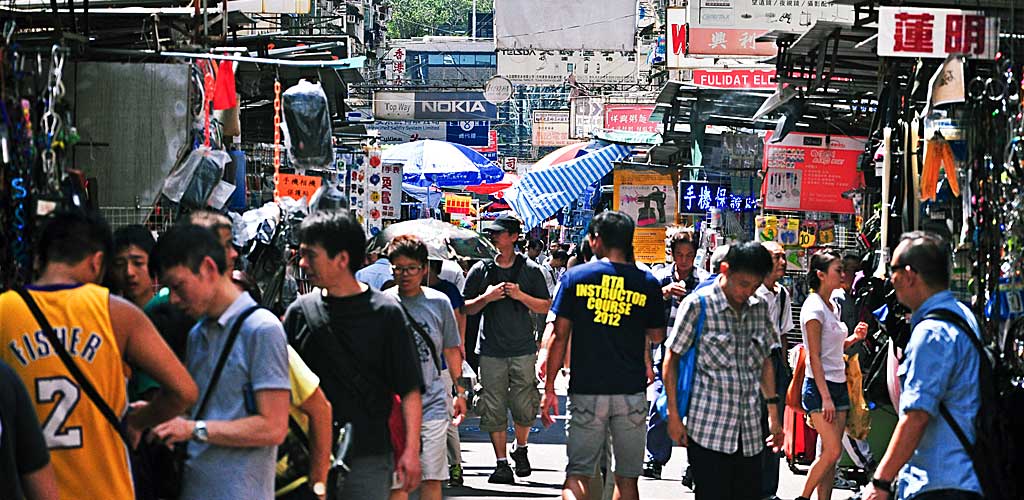
Apliu Street is an open-air market street, and the greater part of it only works on foot. When the Hong Kong Observatory puts a rainstorm or a tropical cyclone signal in force, the question visitors actually ask is a plain one: is it worth attempting, and what does the signal in front of me actually mean? This page answers that from the Observatory's own figures and advice, and lines them up with the one hard fact that governs a visit here — the hours in which the street is a pedestrian precinct. It does not tell you that the market is "closed in a typhoon", because no official source says that. It gives you what is officially known, and leaves the last step to the stallholders who take it.
The street's daily rhythm, in one line
The Transport Department runs Apliu Street (between Kweilin Street and Nam Cheong Street, together with the Yen Chow Street–Kweilin Street section) and Kweilin Street as part-time pedestrian streets, closed to vehicles from 12 noon to 9:00 pm daily. The schemes began on trial in October 2001 and became permanent in May 2002, with the later group confirmed in June 2004.
That window is why the market works the way it does. Before noon the road is still doing its day job — vans and lorries delivering, and the street being cleaned — and the stalls are only setting up. The market is there to be walked, and the Transport Department's own reason for the scheme is the crowd: at Apliu Street the pedestrian volume exceeds 5,500 people per hour at peak, more than the road can carry alongside vehicles. The stalls themselves, in the government's own words, are "generally open from noon till night time".
So the first thing a weather signal affects is not a shop door but the street itself. A morning visit and a rainstorm warning interact in a way an afternoon visit does not: at 10 am you are on a road, not in a pedestrian precinct.
Rainstorm warning signals, level by level
Hong Kong's rainstorm warning system has three levels, and it is issued independently of the tropical cyclone (typhoon) warnings — the two are separate systems and one can be in force without the other. The thresholds below are the Observatory's: heavy rain that has fallen or is expected to fall generally over Hong Kong, and is likely to continue.
| Signal | Rainfall threshold | What the Observatory advises the public to do |
|---|---|---|
| Amber rainstorm warning signal | Exceeding 30 millimetres in an hour | Take the necessary precautions to reduce your exposure to risk posed by heavy rain, such as flooding. Avoid going near easily flooded watercourses. |
| Red rainstorm warning signal | Exceeding 50 millimetres in an hour | Employees working outdoors in areas exposed to rain should suspend outdoor duties if conditions there warrant it. People who have to travel should carefully consider weather and road conditions. |
| Black rainstorm warning signal | Exceeding 70 millimetres in an hour | Stay indoors or take shelter in a safe place until the heavy rain has passed. Employees working outdoors in exposed areas should stop work and take shelter. |
Two points the Observatory makes about reading these levels are worth knowing before you plan around one. First, the rainfall figures are guidance only: when rain is prolonged, a signal can be issued even if the hourly figure for that particular hour is not reached. Second, the levels do not have to climb in order — a Red signal can be issued without an Amber before it, and a Black without a Red. Hong Kong's rainy season normally runs April to September, and the Observatory singles out May and June as the months when rain is "particularly heavy and persistent".
Typhoon signals, level by level
The tropical cyclone warning signals move in steps as a storm approaches and its winds reach Hong Kong. The definitions below are the Observatory's own.
| Signal | What it means |
|---|---|
| Standby Signal No. 1 | A tropical cyclone is centred within about 800 kilometres of Hong Kong and may affect the territory. |
| Strong Wind Signal No. 3 | Strong wind is blowing or expected near sea level, with a sustained speed of 41–62 km/h and gusts that may exceed 110 km/h, expected to persist. |
| Gale or Storm Signal No. 8 | Gale or storm force wind, with a sustained speed of 63–117 km/h from the quarter indicated and gusts that may exceed 180 km/h, expected to persist. |
| Increasing Gale or Storm Signal No. 9 | Gale or storm force wind is increasing, or expected to increase significantly in strength. |
| Hurricane Signal No. 10 | Hurricane force wind, with a sustained speed reaching 118 km/h or above and gusts that may exceed 220 km/h. |
The Observatory is careful to say what a signal is not. The weather in different parts of Hong Kong cannot simply be inferred from the signal issued, and knowing which signal is in force is not on its own enough — the advice is to follow the latest tropical cyclone information and announcements for your area. For a street market this matters in a very practical way: Apliu Street is a row of independently run stalls and shops, and whether any individual stallholder puts up a table on a given day is that stallholder's decision. No official source states that Apliu Street's stalls close under a named rainstorm or typhoon signal, and this page does not pretend otherwise. What is official is the meaning of the signal you can see, and the Observatory's advice on what the public should do about it.
What the months actually look like
Hong Kong's 1991–2020 climate averages show the two ends of the year clearly. This table is drawn straight from the Observatory's monthly normals: mean temperature, mean relative humidity, mean rainfall, the average number of days in the month on which a tropical cyclone warning signal of No. 1 or higher was in force, and the average number of days with a thunderstorm.
| Month | Mean temp (°C) | Mean humidity | Mean rainfall (mm) | Days with TC signal No. 1+ | Thunderstorm days |
|---|---|---|---|---|---|
| January | 16.5 | 74% | 33.2 | 0.00 | 0.23 |
| February | 17.1 | 79% | 38.9 | 0.00 | 0.60 |
| March | 19.5 | 82% | 75.3 | 0.00 | 1.37 |
| April | 23.0 | 83% | 153.0 | 0.20 | 3.13 |
| May | 26.3 | 83% | 290.6 | 0.27 | 5.87 |
| June | 28.3 | 82% | 491.5 | 2.00 | 8.13 |
| July | 28.9 | 81% | 385.8 | 3.13 | 7.97 |
| August | 28.7 | 81% | 453.2 | 4.17 | 8.90 |
| September | 27.9 | 78% | 321.4 | 3.83 | 5.07 |
| October | 25.7 | 73% | 120.3 | 1.70 | 0.83 |
| November | 22.2 | 72% | 39.3 | 0.57 | 0.17 |
| December | 18.2 | 70% | 28.8 | 0.00 | 0.00 |
Read the tropical-cyclone and thunderstorm columns together and the shape of the year is not a matter of opinion. The months with essentially no tropical cyclone warning activity are January to March and December, and they are also the driest and coolest. Rain climbs steeply from April and is at its heaviest in June (491.5 mm) and August (453.2 mm). The windy window is June to September, and on the averages August is the month most likely to have a signal in force at some point (4.17 days), with September close behind. Thunderstorms follow the same curve, peaking in August at 8.90 days on average.
None of this ranks a month as "best". It simply tells you which months carry the most rain and the most wind, so that a trip in June or August is planned as a wet-season trip, and a trip in January or December is not.
Practical kit
A market street is not a mall, so the sensible kit is the kit for being outdoors and on foot for a couple of hours:
- An umbrella or a compact rain jacket. In heavy rain an umbrella alone is awkward between stalls; a light jacket keeps both hands free for handling gear.
- Non-slip soles. Wet tiled and painted surfaces around station exits and stall canopies get slick underfoot.
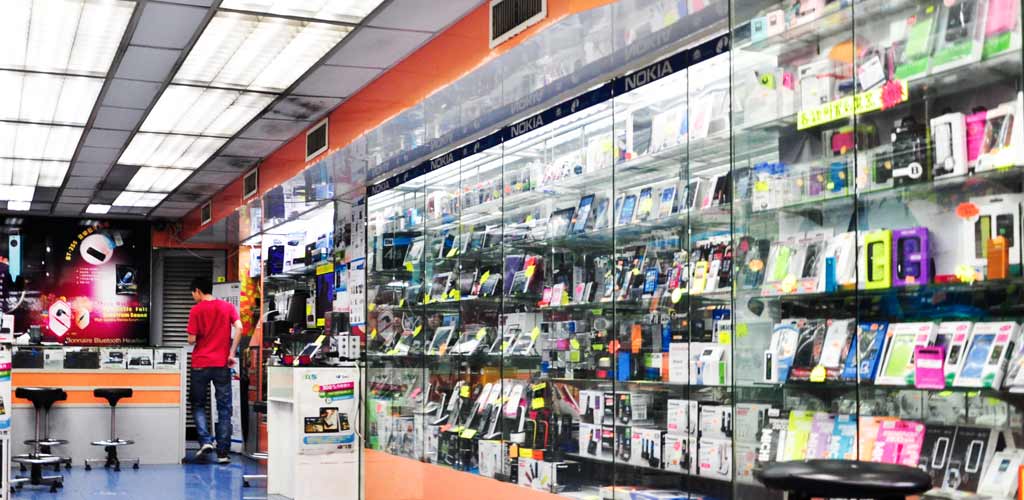
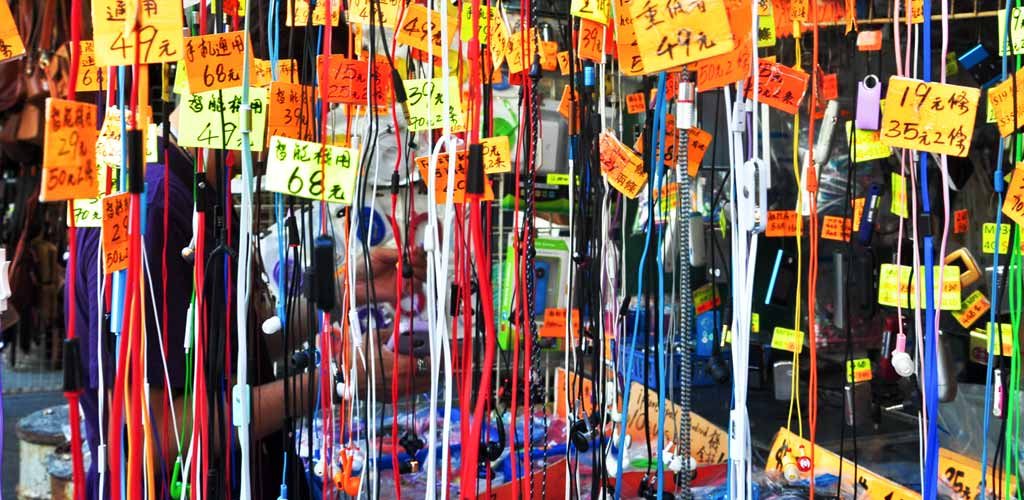
- A power bank and a short cable if you are buying or testing second-hand electronics — you cannot rely on a mains socket in the street.
- Small notes for cash. Many stalls are cash-first; keep notes dry in a zipped pocket rather than an open one.
If in doubt
Check the Hong Kong Observatory before you set out, and again if a day's plans are getting close to a warning. The Observatory's rainstorm and tropical cyclone pages give the current signal and the public advice for it, and its "warning information" pages are the single source both this page and the street itself rely on. If a Black rainstorm signal is in force, the Observatory's advice is unambiguous: stay indoors or take shelter until the heavy rain has passed.
For the hours side of the question — when the stalls are typically trading, and the site's own note on what to expect on a bad-weather day — see our opening hours guide. Keep the two together: the signal tells you what the weather is doing, and the street's own rhythm tells you when it is worth walking into.
While you're here
- The flea market — what is actually on the stalls, and why the pedestrian hours exist.
- How to get to Apliu Street — MTR and bus routes, with the station exit that lands you in the market.
- Maps and the street layout — where the covered and indoor sections are when you want shelter.
- The events calendar — what is on in the district, independent of the weather.
- Opening hours — the market's daily timing in full.
Sources: Hong Kong Observatory — Rainstorm Warning System (hko.gov.hk), Considerations for Issuing Tropical Cyclone Warning Signals (my.weather.gov.hk) and the Observatory's monthly normals, 1991–2020; Transport Department — Pedestrianisation: Sham Shui Po; Film Promotion and Facilitation Section location library; Home Affairs Department — Hong Kong Fun in 18 Districts.